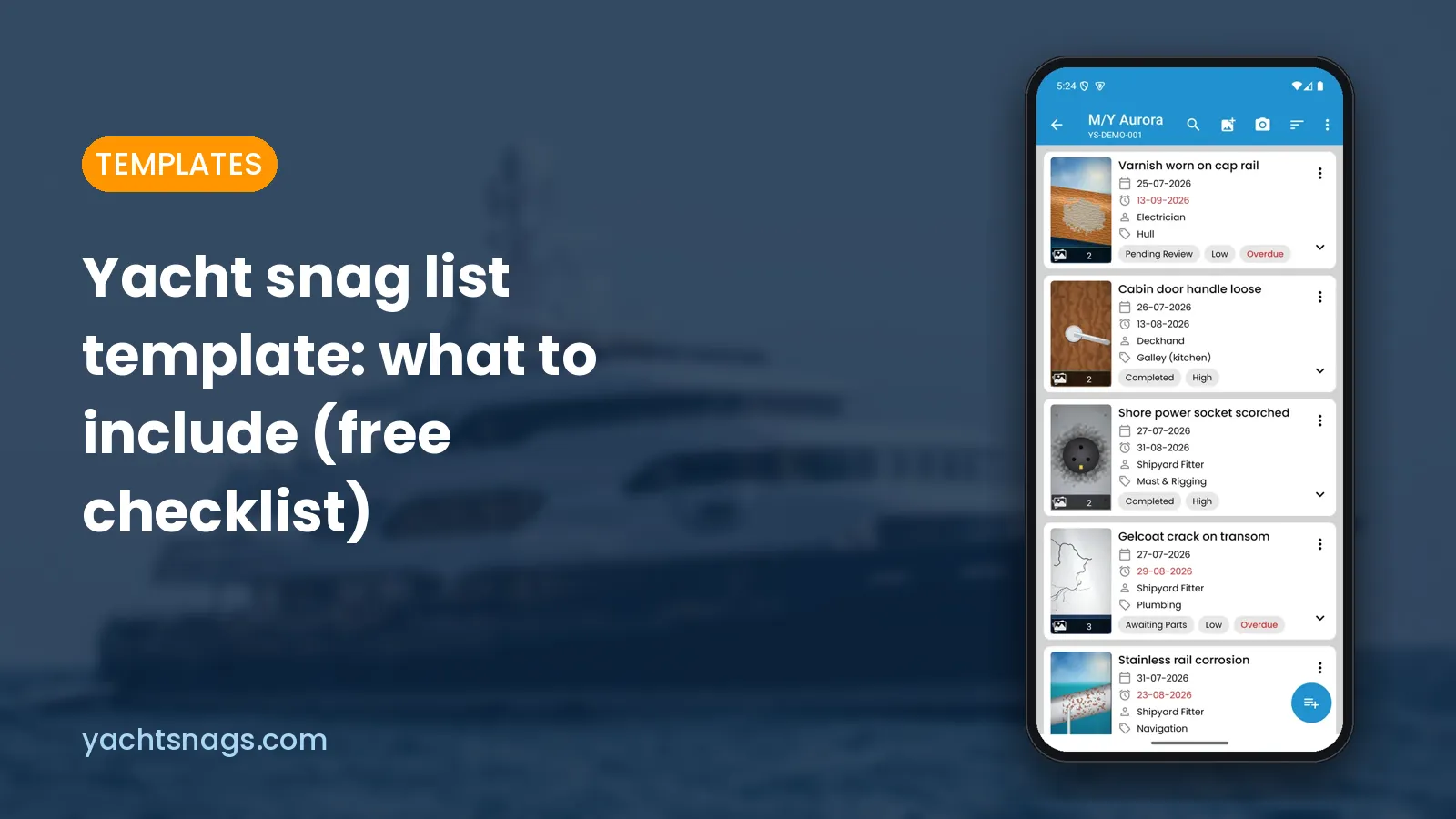
The quality of a defect report decides how fast problems get fixed. A contractor who can understand the issue from the report alone does not need a guided tour, and does not come back with questions. Here is a structure that works.
The four-part description
- What — the component and the defect.
- Where — deck, compartment, side and a reference point.
- How much — size, number, extent.
- Expected result — what “fixed” means.
Examples
| Vague | Clear |
|---|---|
| Door broken | Guest cabin 3 entrance door: handle loose and latch does not engage. Tighten handle, adjust strike plate so the door closes and latches. |
| Paint damage | Main deck, starboard side, frame 22: two chips in topsides paint, approx. 10 mm each. Fill, fair and touch up to match. |
| Socket burnt | Shore power socket, aft deck locker: scorch marks on housing and pins. Isolate, replace socket and check cable termination. |
Photos that explain themselves
- Take one wide photo for context and one close-up.
- Circle or arrow the exact spot; add a short text label if useful.
- Include a scale reference (a coin, a ruler) for size.
Neutral, factual language
Describe what you see, not who is to blame. “Sealant missing at joint” is better than “poor workmanship”. If you suspect a cause, label it as a suspicion.
Let the tools help
Voice dictation lets you describe a defect while your hands are busy. On supported phones, YachtSnags can draft the description from the photo and tidy up spelling and grammar — always read and adjust it before sharing.
Do this on your phone. YachtSnags turns this checklist into a live snag list: photo, mark-up and status for each item, then a branded PDF report in one tap. Download free for Android and iOS.